
Common Questions
Answers, without the sales pitch
Common Questions About Pelvic Floor Training
These are the questions that come up most often, answered as plainly as we can. Where the honest answer is "it depends" or "ask a professional", we say so. Nothing on this page is medical advice, and nothing here is a promise about what training will do for you.
Before you read further
This page explains how pelvic floor training is usually described and what to check as you go. It is not a diagnosis, and it is not a substitute for an assessment. If something hurts, or if leakage is affecting your day, that is a conversation for a qualified professional.
Written for readers in Indonesia. Working hours and contact details are on the Contact page.
Finding the muscles and doing the movement

A first attempt is easier seated or lying down, where other muscles are less likely to take over.
The usual discovery cue is to squeeze as if stopping the flow of urine. Use it to locate the sensation, then practise away from the toilet. A correct contraction does not need your stomach, thighs, or buttocks, and you should be able to count out loud while you hold. If the movement stays unclear after a few honest attempts, or if it hurts, an assessment is the faster route than more guessing.
Locating the sensation
The cue is a starting point, not a training method. Use it once or twice to learn what the contraction feels like, then move to a quiet room and repeat it there without the toilet in the room.
What a clean contraction feels like
A lift and squeeze that stays internal. Your stomach stays soft, your thighs stay still, your buttocks stay out of it. If you can talk or count out loud while holding, the effort is in the right place.
When to stop guessing
If the movement stays unclear after a few sessions, if you feel a pull where there should be none, or if anything hurts, book an assessment. More repetition on an unclear movement is not the fix.
Reps, sets, and how fast to build
Beginners commonly start with a small set of slow reps once or twice a day, and add more only when the current set feels controlled throughout. There is no number that suits everyone, and this site does not publish a target. The signal to add reps is clean form from first to last, not the calendar.
Start smaller than you think
A handful of slow reps, held for a comfortable count, is the usual opening. Short and controlled beats long and strained. Stop the set while the last rep still feels as clean as the first.
The signal to add more
Add reps only when the whole set feels controlled from start to finish, and add them a little at a time. A calendar date is not a reason to increase anything. If form slips in the middle of a set, you added too early.
Rest and breathing
Breathe normally through the hold and let go fully between reps. Holding your breath or bracing your stomach turns a pelvic floor exercise into a different exercise. Rest days belong in a routine; they are not a missed day.
If you miss a week
Resume on the next day at the level you left off. Doubling up to catch up usually ends in strain and a longer pause. The daily routine builder has a sample week if you want something concrete to follow.
Positions and progression
Lying down, seated, standing
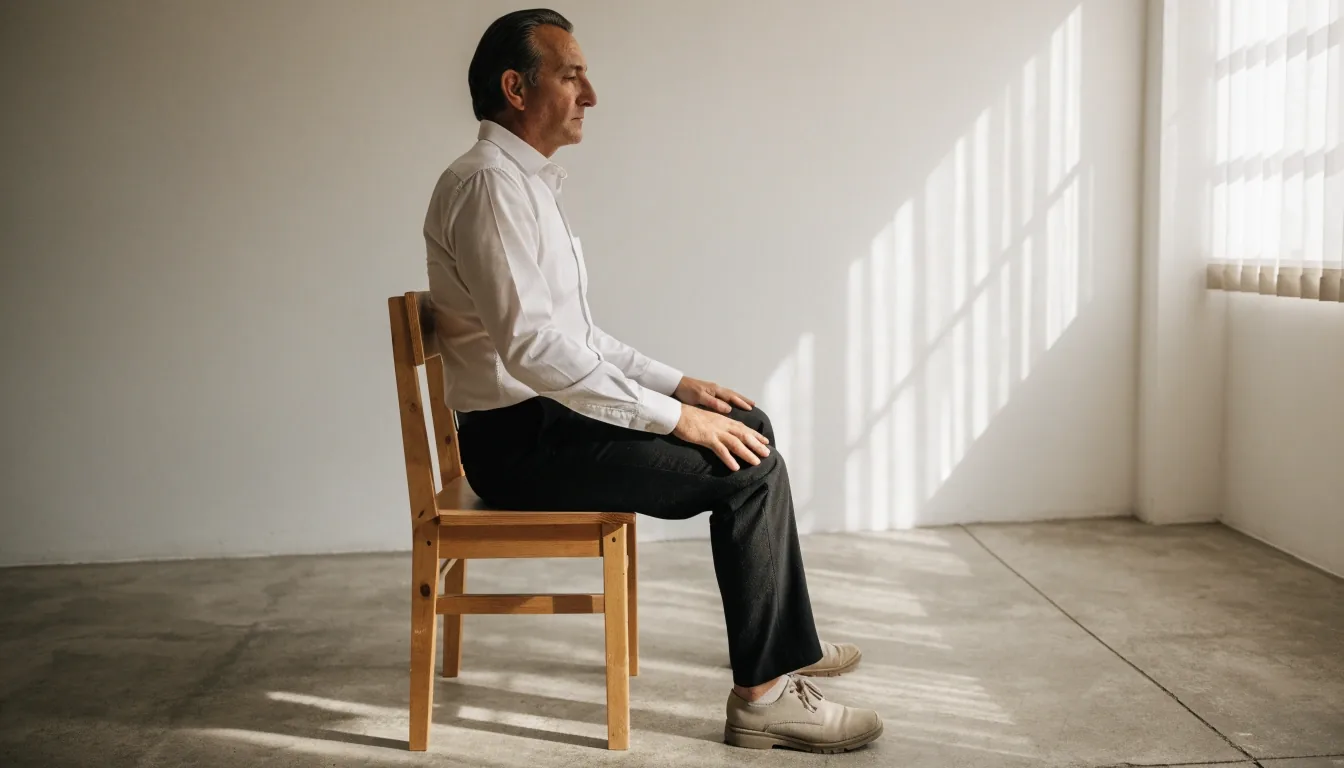
Lying down is the usual starting position because it reduces effort from other muscles. Seated practice comes next and is the easiest to fit into a working day. Standing practice is generally presented as a later step and is the one that most resembles daily life. Move on when the contraction is easy to find where you are, not on a fixed schedule.
You can practise without anyone noticing, which is why seated reps are popular at work. Standing reps are the ones people tend to reach for while waiting in line or standing at a counter.
Timing and realistic expectations
Guidance does not offer a fixed timeline, and this site will not invent one. What the material describes is that the movement becomes easier to locate and control with regular, relaxed practice. If you are looking for a date by which something specific will change, that is a conversation for a clinician, not for a website.
That is also why no numbers appear on this page. A specific count of reps, or a specific number of weeks, would be a guess dressed up as guidance. The useful measure is whether the movement is getting easier to find and hold where you are.
When to see a professional
See someone if you have pain, if leakage is affecting your day, if you cannot tell whether the muscles are working, or if you are unsure whether pelvic floor work suits your situation. One 2024 men's pelvic health article notes that Kegels can have a place in discussions about pelvic floor pain and dysfunction, and it recommends assessment first so the approach is appropriate. That is a sensible default.
An assessment is not a last resort. It is a way to find out whether pelvic floor training is the right thing for your situation, whether something else needs attention first, and whether the movement you have been practising is being done in a way that helps.
- Pain during or after the contraction.
- Leakage that is shaping where you go or what you plan.
- You cannot tell whether the muscles are working at all.
- You are unsure whether this kind of training suits your situation.

A plain mat and a quiet room are enough. If the movement hurts here, stop and get it looked at.
Practicalities of daily practice
You can practise without anyone noticing, which is why seated reps are popular at work. Rest days are part of a routine rather than a failure of one. If you miss a week, resume on the next day instead of doubling up. Our daily routine page has a sample week if you want something concrete to follow.
At a desk
Seated reps fit between tasks. Sit square, let your shoulders drop, and run one small set. Nothing about your posture needs to change enough for anyone to notice.
On a commute
Standing reps are easy to slip into a wait at a counter or a stop at a light. Keep the set short and keep breathing normally. If you catch yourself bracing, drop the set and try again later.
At home, in the evening
A short set on a mat before bed is the version most people find easiest to keep. Keep it short enough that it does not become a chore, and skip it on the days you feel strained.
Keeping a light record
A note of when you practised and how the set felt is more useful than a count of reps. Over a few weeks it shows whether the movement is getting easier to find, which is the thing worth tracking.
A sample week, in short
The daily routine builder lays out a week with rest days built in and no target numbers to chase. Use it as a shape to copy, not a schedule to obey.
Build a weekly routineQuestions we hear most
Short answers to the questions that come up again and again. If yours is not here, the Contact page is the place to send it.
How do I find the correct muscles without guessing?
Use the stop-the-urine-flow cue once to identify the sensation, then practise away from the toilet. Guides warn against using it as repeated training.
How many repetitions should a beginner do each day?
Start with a small set of slow reps once or twice a day and add reps only when the set feels controlled throughout. There is no single number that fits everyone.
Should Kegels be done lying down, sitting, or standing?
Lying down is the usual starting point. Seated and standing practice are generally presented as progressions once the contraction is familiar.
How long before pelvic floor exercises feel natural?
There is no fixed timeline, and this site does not promise one. Most guidance describes the movement becoming easier to control with regular practice.
Can I do these exercises without anyone noticing?
Yes. The contraction is internal, so seated and standing practice can be done quietly in ordinary settings.
Should I pause the routine if I feel I am straining or holding my breath?
Yes. Stop the set, breathe normally, and restart with fewer reps or in an easier position.
Is pelvic floor training a treatment for a medical condition?
This site presents it as an educational exercise topic, not a treatment. If you have a medical concern, an assessment is the appropriate next step.
Still not sure, or want a second opinion?
Send us the question you actually have, in your own words. We read messages during working hours and reply in English. If your question is about a symptom, pain, or something that has changed, we will point you to an assessment rather than answer it here.
If you would rather start reading first, the pelvic floor basics page explains the muscles and what they do, and the Kegel routine page walks through the movement step by step.
- [email protected]
- Phone
- +62 21 573 1838
- Working hours
- Monday to Friday, 9:00 AM – 6:00 PM (WIB)
- Address
- Jl. Kemang Raya No. 28, Bangka, Mampang Prapatan, Jakarta Selatan, DKI Jakarta 12730, Indonesia